Showing posts with label The oldest Schochenmaier ever. Show all posts

Saturday, July 18, 2015

The oldest Schochenmaier ever 2.0

As we proved in some previous posts that Leopold Schochenmeyer was not the oldest Schochenmaier (because he was Schahenmeyer from Austria), I am asking myself again who actually had been the first Schochenmaier. Well, of course, it cannot be the very first Schochenmaier, but the first one known to us from the archives.

Let me remind you of Maria Schochenmeyerin which I presented to you attention on October 2014. Yes, it's strange enough to state that the oldest known Schochenmaier is a woman. Therefore, we suggest that she should have had a father with the same family name. Let's go deeper into details:

Playing with the spellings of Schochenmaiers, I stumbled upon a woman with the name of Maria Schochenmeyerin who, being married to Michaele Dettling, got a baby Christoferus Dettling in 1676 in Altheim.


1. The forename of Michaele Dettling is written in a correct way, it's just a south dialectal form of the full name Michael that expresses any aspect of being "small". It might be read like Mikhele (compare with the Swiss Company name "Nestle" - small nest);

2. The spelling of Maria Schochenmeyerin corresponds to that of Sara Schachenmeyerin where I explained that "It's not a problem at all. In the Southern Germany until the 18th century (and in the Bavarian dialect till now!) the female family names got ending -in.So, we may conclude that father of Maria had had the surname of Schochenmeyer. 

3. If Maria bore a child in 1676, she could be born between 1640s and 50s. Thus, her farther X Schochenmeyer should have been born in 1620-30s(?). But there are no hints in the digitized resources about him or any other relatives

4.  Maria had got her child (1676) in the catholic Altheim of the Schwarzwaldkreis within Württemberg. Where is it?

On Wikipedia you may find three different Altheims:


  • Altheim, Biberach, a municipality in the district of Biberach, Baden-Württemberg
  • Altheim (Alb), a municipality in the district of Alb-Donau, Baden-Württemberg
  • Altheim (Ehingen), a municipality in the district of Alb-Donau, Baden-Württemberg


  • All of them are not far from each other, but it's not Schwarzwald. On the net you may find a hole list of areas which made part of Schwarzwaldkreis:

    Below are the Oberamt cities for the Schwarzwaldkreis area of Württemberg: 
    Oberamt Balingen 
    Oberamt Calw 
    Oberamt Freudenstadt 
    Oberamt Herrenberg 
    Oberamt Horb 
    Oberamt Nagold 
    Oberamt Neuenbürg 
    Oberamt Nürtingen 
    Oberamt Oberndorf 
    Oberamt Reutlingen 
    Oberamt Rottenburg 
    Oberamt Rottweil 
    Oberamt Spaichingen 
    Oberamt Sulz 
    Oberamt Tübingen 
    Oberamt Tuttlingen 
    Oberamt Urach


    Under Oberamt Horb you may find the following:

    Parish Cities/towns for Oberamt Horb

    .........

    So, we found out where there was another Altheim in Schwarzwald, that is a part of Horb today.

    Horb am Neckar is a town in the southwest of the German state of Baden-Württemberg. It is located on the Neckar river, between Offenburg to the west (about 56 kilometres (35 mi) away) and Tübingen to the east (about 29 kilometres (18 mi) away).


    In addition to the main town of Horb, the municipality includes a number of communities which are recognised within the terms of the 1970s Baden-Württemberg local government reform, that is they have an elected council and council chairman. These are Ahldorf, Altheim, Betra, Bildechingen, Bittelbronn, Dettensee, Dettingen, Dettlingen, Dießen, Grünmettstetten, Ihlingen, Isenburg, Mühlen, Mühringen, Nordstetten, Rexingen and Talheim, the last of which is made up of the formerly independent parishes of Obertalheim and Untertalheim. These are referred to formally (for example, in postal purposes) as Horb-Ahldorf, Horb-Altheim, etc. 

    The history of Horb is relatively boring because from 1381 to 1806 it belonged to Austria, and that's why it was officially Catholic:


    Further Austria or Anterior Austria (GermanVorderösterreich, formerly die Vorlande (pl.)) was the collective name for the early possessions of the House of Habsburg in the former Swabian stem duchy of south-western Germany, including territories in the Alsacer egion west of the Rhine and in Vorarlberg
    While the territories of Further Austria west of the Rhine and south of Lake Constance were gradually lost to France and the Swiss Confederacy, those in Swabia and Vorarlberg remained under Habsburg control until the Napoleonic Era.

    Here is the Württemberg map of the 17th century. The Austrian territory is highlighted with brown:


    Some pictures of Altheim in Horb:

    Altheimer Tor in Horb


    The Catholic Church of St. Maria's Birth does exist till now. Who knows, maybe Maria Schochenmeyerin christened their children here: 


    I should add that on November 1677 Maria will get another boy called Conrad:


    but before those two boys she had got a girl Catharina Detling on the 29th March 1671: 


    So, she had two boys Conrad and Christofer who were Dettling as their father Michaele Dettling. 

    The surname distribution map proves that the highest rate of Dettling family name is precisely in Horb a.N. The bearers of this surname organized a real club dedicated to their genealogical research: http://www.dettling-familiengemeinschaft.de/index.shtml
     
    I have contacted them to question if they have any information on our Maria Schochenmeyerin but I have got no response since then. 

    Thanks for your attention and interest.    

    Tuesday, May 26, 2015

    Is the oldest Schochenmeyer fake?

    On July 2014 I wrote about the oldest Schochenmaiers ever. I was really surprised that they had lived near to place where I am actually living. That's why I decided to check in the local archives. What I found out was even more interesting.

    First, I remind you what is to be seen on FamilySearch about the oldest Schochenmaiers:

    The oldest notice on the FamilySearch refer to Maria Schochenmeyer born on the 2nd March(baptized on the 7th March) 1652 in the family of Leopold Schochenmeyer and Anna Seueber at the Britzingen village (Lörrach area, in Baden):

      If the information is right, then Leopold Schochenmeyer should be born between 1620s-1630s, it's the beginning of the 17 century. So, we may suggest that the company had been found earlier, maybe between late 16th - early 17th century, or during the 16th century.


    I was so proud of that information for it was pretty "ancient" and believable that I went to the local archives of the Freiburg University Library in order to take a picture of this notice. Below you'll find what I found in the historical book of Britzingen (village within Müllheim): 


    Well, as you may see, we've got "Schahenmeyer" but no "Schochenmeyer".  For a handwritten text, the difference is of small account. a is twisted up with oc.  Who's wrong?

    Let's compare the resources of the both notices. 

    The first one is from FamilySearch: 


    The FamilySearch.org website offers free access to digital images of genealogical records. These images can be searched along with a number of databases. The library holds genealogical records for over 110 countries, territories, and possessions, including over 2.4 million rolls of microfilmed genealogical records; 742,000 microfiche; 310,000 books, serials, and other formats; and 4,500 periodicals. The microfilm and microfiche can be ordered and viewed at over 4,000 library branches (called Family History Centers) worldwide. FamilySearch also offers research help through the FamilySearch Wiki, Forums, digitized books, and online free family history courses through the Learning Centre.

    Ok, but who is transcribing the images from parish books? 


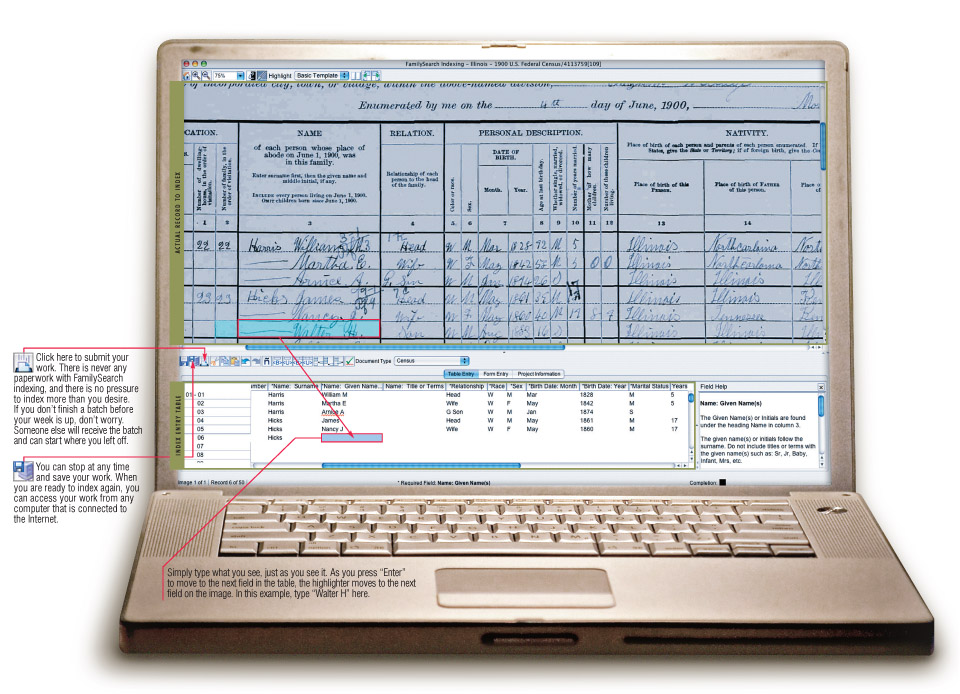
    FamilySearch is in the process of digitizing its entire microfilm collection and making those images available online. The searchable indexes are created by volunteers using FamilySearch Indexing software developed by the LDS Church. To ensure greater accuracy, each batch of records is indexed by two separate indexers and any discrepancies are sent to an expert arbitrator. FamilySearch Indexing volunteers need not be members of the LDS Church. FamilySearch is currently working with genealogical societies all around the world to index local projects. At the end of 2010, 548 million vital records had been transcribed and made publicly available through the FamilySearch website. In April 2013, FamilySearch Indexing completed their goal to offer 1 billion indexed records online.


    Let it be!

    The second resource is a historical work from 1973 containing 4.896 families within 1602-1973 on 580 pages titled

    Ortssippenbuch Britzingen mit den Ortsteilen Dattingen, Muggardt und Güttigheim, Landkreis Breisgau-Hochschwarzwald/ Baden 

    The Ortssippenbuch is a book of the compiled records from a parish and sometimes from other local sources that organize people and their events into family groups. Each family group is usually assigned a number within this book and that family number leads to other family numbers so that you can connect numerous family generations together. Dates are given for births/baptisms, marriages and deaths and burials. It lists all the children that are born in this village and also if parents have come from elsewhere as well as other useful information. You might even find a reference if your ancestor immigrated to another country.

    by Rolf Eilers (genealogist from Freiburg, http://www.rolf-eilers.de/)


    and Eugen Eble, and  Albert Hofmann

    So, if you asked me, who I believe and what is more plausible, I would prefer the German genealogical work. Choosing between American indexers / expert arbitrators and German family researchers, I'd vote for the latter ones. I think they have more experience in the German Gothic handwriting.

    Besides that, let's pay attention to what is in.

    Leopold Schahenmeyer - full name

    in Dattingen    - local area, neighbor village of Britzingen, part of Müllheim

    aus dem "Ländlin ob der Endtz" - this inscription is the most interesting because it corresponds to "aus dem Ländlein ob der Enns" or "aus Österreich"It means that this person had come to Britzingen from Austria!!!! In this regard, in the book I found the following: "The village was then populated by people from the "Ländlein ob der Enns", whcih is today a part of western Austria". Those people came to Germany after the Thirty Years' War (1618-1648).

    Well, we may conclude that Leopold SchAhenmeyer was not of the German SchOchenmaier origin. He was Austrian.

    May I remind you that I have already explained the origin of Scha(c)henmeyers in the post on the solved puzzle. It was based on the work of Wolfgang Petz, Die Familie Schachenmayer in Kempten und Isny vom ausgehenden Mittelalter bis zur Mitte des 19. Jahrhunderts (Schachenmayer Family in Kempten and Isny from the Late Middle Age up to the middle of the 19th century), Typoskript Kempten 2003. It probably traces back to the field name of Schachen in Langenegg, a municipality in the district of Bregenz in the Austrian state of Vorarlberg where we can find the very first mention in 1506 about the hunter Michael Schachenmmayer.

    So, we stated that there was no German Leopold Schochenmeyer but Austrain Leopold Schahenmeyer. I've learnt that I should be careful with the data from FamilySearch.  Now the palm of victory is going to Johann Schochenmajer here:

    Chronologically, the second mention on the oldest known Schochenmaiers refers to Johanna Christina Schochenmajer born on September 19, 1716 in Kornwestheim to Johann Schochenmajer and Anna Maria Schochenmajer.


    If so, Johann Schochenmajer should be born in 1680s-1690s. 

    Kornwestheim is a town in the district of Ludwigsburg, Baden-Württemberg, Germany. It is situated about 10 kilometres (6 miles) north of Stuttgart, and 5 kilometres (3 miles) south of Ludwigsburg:


    That town is a lot older; Ludwigsburg was only founded in 1704, while Kornwestheim is, as far as I know, more than 1.200 years old, and while Ludwigsburg was carefully planned by the duke of Württemberg's court architects, Kornwestheim is a place that grew naturally, starting out as an Alemannic settlement with farms and not much else. 


    It's almost one hundred years later and 140 miles (230 km) northward. It means we should start again searching deeper and it's good that we could cast out the wrong persons from our family tree.

    Let's go on!!!  

    Saturday, July 12, 2014

    The oldest Schochenmaiers ever

    In order to find out when two different families (very possibly the Schochs and the Maiers) could, according to Jacob Schochenmaier, found their joint wagon and buggy company in Germany, we should search for the very first mention of Schochenmaiers in the history.

    I will present my first results for both the Schochenmaiers and the Schachenmayrs.

    Let's start with the very first mention of Schochenmaiers that means the oldest ones which can be found anywhere.

    The oldest notice on the FamilySearch refer to Maria Schochenmeyer born on the 2nd March (baptized on the 7th March) 1652 in the family of Leopold Schochenmeyer and Anna Seueber at the Britzingen village (Lörrach area, in Baden):


      If the information is right, then Leopold Schochenmeyer should be born between 1620s-1630s, it's the beginning of the 17 century. So, we may suggest that the company had been found earlier, maybe between late 16th - early 17th century, or during the 16th century. The production of the company might look like that:


    There is no information about Leopold himself, he's mentioned as father of Maria.


    On the place

    Britzingen is indicated as place of birth. Today it's an administrative part of Müllheim:


    Britzingen with his district Dattingen and the romantic villages Güttigheim and Muggardt is located in the heart of Markgräferland, in the foothills of the southern Black Forest, on the edge of the Rhine valley.

    Here you can see Britzingen between French Mulhouse, Swiss Basel and German Freiburg (where I am living!)


    In 1526 Britzingen as part of Markgraf (Margrave) became Protestant following the actions of the German monk Martin Luther. It's evangelical:


    The two villages, Britzingen and Muggardt, belong together. Britzingen is a well known wine- and vacation resort with lots of private places to stay and some good restaurants.


    The Winzergenossenschaft Britzingen, a local wine cartel, and the private wine cellars of the Behringer family, produce a fine wine.


    They have customers as far away as Japan.  Wine cellar tours and wine tasting are being held regularly during the summer months.


    Here you can see even a house of the 17th century:


    On the time

    1620-1650s - was time when Britzingen had been a part of the Baden-Durlach within Margraviate of Baden:


    It's highlighted with whity-brown on the left at the bottom (where is Müllheim). 

    The name translates to Margraves' Land, in reference to the Margraves of Baden. They ruled the area from the 12th century as a margraviate of the Holy Roman Empire until its elevation to the Grand Duchy of Baden in 1806, following the Empire's dissolution. Markgräflerland is the combination of three duchies: Badenweiler, Rötteln and Sausenburg.The river Rhine marks the frontier to France in the west and Switzerland in the south.

    Before his death, the prince Christopher I divided the Margraviate between his three sons. Philip succeeded him in 1515 but died childless in 1533, and his share went to his brothers, Bernard and Ernest. In 1535, they made a fresh division of their inheritance. It would be the first of several partitions, establishing the two main lines of the House of Baden – Baden-Baden and Baden-Durlach (Baden-Pforzheim until 1565) – which would last until 1771. However, the relations between the two lines were not peaceful, and the constant fragmentation did not help.

    During the Reformation, several branches, led by Baden-Baden, remained on the side of the Catholics, the others joining with Baden-Durlach on the Protestant side. The Thirty Years War made matters worse for all the branches. Many of them were exiled to other countries. Baden suffered severely during the war. The 1648 Treaty of Westphalia restored the branches and their churches to their own lands. Gradually the rivalry subsided. During the wars of Louis XIV, the "Sun King" of France, the two Margraviates were ravaged by the French troops. The forces of the Holy Roman Empire, led by the Margrave of Baden-Baden, “Turk” Louis William (reigned 1677-1707) fought against France. 

    So far for today. Now we know the names of the first Schochenmaiers ever! But where had been the second ones?